If you’ve done even a little programming then you’re also good at finding ways to waste time watching things vaguely related to it. Admit it, you’ve spent at least a few hours watching videos about Android’s latest features or Chrome’s Internals even though you’ll never write a single line of code for either. Don’t worry, I’m not going to list a bunch of technical talks. We’re talking entertainment for after the work day. The following movies are stimulating to watch for those with a programming oriented mind. And you know what that means, softcore porn!
Welcome to Macintosh
Netflix Streaming? Yes
Apple documentary that does a great job tracking the reasons for its successes and failures. I wasn’t sure I’d like the movie after reading the description on Netflix, but once the interview with a grumpy and inebriated ex-Apple Engineer started I was sold. Just gets better from there.
The IT Crowd
Netflix Streaming? Yes, series 1, 2, and 3. 4 is available on iTunes for ten bucks.
Lets face it, if you’ve done any programming at all then you’re also the go to IT person for your entire extended family. Over Thanksgiving I’m sure everyone one of you spent at least a few hours exercising the Tech Support Cheat Sheet. The main focus of this show quickly diverges from IT, but each episode still includes references to nerd popculture.
We Live in Public
Netflix Streaming? Yes I can’t believe I had never heard of Pseudo. If you haven’t, then make this the first movie you watch off this list. You’ll be shocked that something like this existed in the late 90’s. Also a bit of nudity sprinkled throughout, just for fun.
The Social Network
Netflix Streaming? No, not even out on DVD yet I’ll leave this description up to the awesome blogger, Mike Rundle:
“The Social Network was fucking awesome. Do not see it if you have an idea in your head because it’ll make you want to work on it 24/7.”
Hackers
Netflix Streaming? Yes I had to include it, this one is sentimental for me. It was the first movie I had seen that showed computer nerds in an enviable light and not as pariahs being put in lockers. The brief sensual scene with Angelina Jolie made this a childhood favorite.
Pirates of Silicon Valley
Netflix Streaming? No, but you can watch it on Google Video.
Yea I can’t believe that’s still around either. I’ll admit it, I’m too young to have actually been paying attention when the events of this movie were actually taking place, it gives a nice synopsis of how Microsoft and Apple ended up where they were in the late 90’s.
Revolution OS
Netflix Streaming? Yes Some nerd cred if you ever wind up trapped in the same room as an old Cobol sysadmin.
Office Space
Netflix Streaming? No
This one is last because I’d be really freaking surprised if you haven’t seen it. It will help you better understand why that creep guy in your office covets his red stapler.
That’s it! Please let me know if you have any other favorites that I did not list in the comments below. I’ll watch them, and if I get enough suggestions I’ll post a second list in the future.
Microsoft shipped Windows 1.0 on November 20th, 1985. Twenty-five years and two days later, it’s not just hard to remember an era in which Windows wasn’t everywhere–it’s also easy to forget that it wasn’t a given that it would catch on, period.
The company had announced the software in November of 1983, before most PC users had ever seen a graphical user interface or touched the input device known as a mouse. But by the time Windows finally shipped two years later, after a series of embarrassing delays, it had seemingly blown whatever first-mover advantage it might have had. At least four other major DOS add-ons that let users run multiple programs in “windows” had already arrived.
In a pattern that Microsoft would repeat with later products, though, it managed to make being late to the party work in its advantage. For one thing, Windows’ super-premature announcement left those four earlier packages competing with it even though it didn’t actually exist yet; many people sensibly postponed buying any “windowing” environment until it was clear how things would pan out.
For another, most of the developers of the earliest Windows rivals shot themselves in the foot, usually more than once: They released products that required cutting-edge machines which few people owned, or got ensnared in lawsuits, or failed to get third-party developers on board. Just as several of them were running out of steam, Windows arrived on the scene. And even though it didn’t gain traction for nearly another half a decade, that was okay; nothing else became a hit in the interim.
“Our approach is that there is only going to be one winner,” InfoWorld quoted Microsoft marketing honcho Steve “Bulmer” as saying in November of 1983, shortly after Windows was announced. The publication got his name wrong, but he couldn’t have been more right about the market.
For the purposes of this roundup of Windows rivals, I considered only environments which were designed to run on IBM-compatible PCs, and which (like pre-1995 versions of Windows) ran on top of DOS rather than replaced it. (That’s why the Mac OS and OS/2, for instance, aren’t here.) I also cover only products released in 1990 or before; once Windows 3.0 was released, Microsoft’s package became a juggernaut and attempts to compete with it largely ended.
That still leaves half-a-dozen significant Windows rivals. They may have failed to compete with Microsoft, but they were all interesting failures. And on Windows’ 25th anniversary, they deserve to be remembered.
Visi On
Publisher: VisiCorp Debuted: December 1983, a year and eleven months before Windows
Why it was better than Windows, or at least different: If pure prescience and ambition could ensure a product’s success, Visi On would have been a blockbuster. The follow-up to VisiCalc–the first spreadsheet and the young industry’s biggest hit to date–Visi On was the first full-blown windowing environment for PCs. It had a mouse-driven (although text-based rather than graphical) interface. And VisiCorp supplied a full suite of integrated apps–required, since it didn’t run DOS apps–that included Visi On Word, Visi On Calc, and Visi On Graph. People who saw early demos were reportedly so blown away that some of them thought it was running on an artfully-concealed minicomputer rather than a PC.
What the critics said: “In summary, the VisiOn system is a milestone in personal computing software. Like many other milestones, it both points the way towards the future and falls far short of it.”
–Thomas Bonoma, Softalk
The publisher called it: “a ‘boss’ who instructs the computer on how to deal with the specific applications you want to work with…Since all these applications work for the same boss, they all work the same way. Learn to use one, and you’ve essentially learned to use them all.”
What happened: What didn‘t happen? VisiCorp thought it would be able to get Visi On running on floppy-based PCs, but by the time it shipped it required 2.2MB of hard-disk space, in an era when a PC with two floppy drives was considered luxurious. Buying all the software and the mouse cost a stiff $1765. And at the same time the company was trying to get Visi On off the ground, it was beset with legal and financial woes–VisiCalc creator Software Arts was suing it, and Lotus 1-2-3 was rendering VisiCalc obsolete. Reviews of Visi On were mixed at best: InfoWorld was respectful, but pointed out that the spreadsheet was harder to use than VisiCalc and forty times slower at recalculating a large spreadsheet. In August of 1984, VisiCorp sold Visi On development rights to Control Data; three months later, it sold itself to a company called Paladin; by early 1986, weeks after Windows was released, Visi On was already effectively dead.
TopView
Publisher: IBM Debuted: February 1985, ten months before Windows 1.0 Why it was better than Windows, or at least different:TopView began as an IBM research product around 1980–before the IBM PC had reached the market. It was announced in August of 1984 at the same time as IBM’s powerful PC AT, and was intended to leverage that machine’s potent technical capabilities. (It required 512KB of RAM and two floppy drives, fairly imposing specs at the time.) Rather than requiring all-new graphical applications, TopView was designed to run DOS programs, but third-party developers could also write “TopView-aware” apps that took advantage of its advanced capabilities. Pundits wondered whether it was designed to eventually supplant DOS, making it harder for third-party PC manufacturers to compete with IBM.
What the critics said: “I was impressed by the concept and IBM’s demonstrations, but, after using the recently released product, I’m less enthusiastic.”
–Larry Magid, Los Angeles Times
The publisher called it: “[a] new kind of software program that lets you run and ‘window’ several other programs at once.”
What happened: Like Windows, TopView was announced and hyped well before it was ready. Two months after it finally hit the market, InfoWorld’s John C. Dvorak was already comparing it to the PC Jr.; few developers bothered to write TopView-aware software, configuring stock DOS apps to run with the package was notoriously tricky, and IBM reportedly sold only a few hundred copies a month. In August of 1985, Big Blue signed a deal with Microsoft to develop operating systems together, and the tech press immediately began speculating that the agreement marked the end of the road for TopView. (The IBM-Microsoft arrangement eventually led to the creation of OS/2, which shipped in December of 1987.) TopView wasn’t officially discontinued until mid-1990, but by that point just about everyone who found the idea intriguing had switched to Quarterdeck’s DESQview.
GEM
Publisher: Digital Research Debuted: February 1985, ten months before Windows 1.0
Why it was better than Windows, or at least different: By the mid-1980s, Digital Research was famous mostly as the company whose CP/M operating system was displaced in the market by Microsoft’s CP/M knockoff MS-DOS. But it got a chance to start fresh with GEM (Graphical Environment Manager). The package beat Windows to the market and looked far more like Apple’s groundbreaking Macintosh. The company also released an array of productivity apps for its environment, such as GEM WordChart; one very popular third-party app, Ventura Publisher, ran on top of a run-time edition of GEM. A modified version of GEM also served as the interface for Atari’s ST line of computers.
What the critics said: “…offers IBM PC users a Macintosh interface.”–Keith Thompson, InfoWorld The publisher called it: “…not just software. It’s a movement.”
What happened: GEM ran into trouble almost immediately; shortly after its release, Apple sued over its Mac-like look, forcing Digital Research to release a new, less elegant edition. It never managed to give Windows serious competition, but it did muddle along into the 1990s, along with Digital Research’s MS-DOS workalike DR-DOS. Novell, which bought Digital Research in 1991, thought DR-DOS had potential but didn’t do much of anything with GEM. Still, the software was open-sourced in 1999 and continues to exist, at least sort of, as FreeGEM and OpenGEM.
DESQview
Publisher: Quarterdeck Debuted: July 1985, five months before Windows 1.0
Why it was better than Windows, or at least different: DESQview was based on DESQ, an earlier Quarterdeck product, and was initially marketed as a superior alternative to IBM’s TopView. Resolutely text-based and keyboard-oriented, it allowed for efficient multitasking of DOS apps and came with QEMM, a famously well-done memory manager that was also available separately. (This was back when PC users had to obsess over the 640KB memory limit and devote energy to figuring out how to override it.) People who liked DESQview really liked it; well into the 1990s, there were folks who swore off Windows and saw it as a way to avoid the whole graphical user interface revolution.
What the critics said: “…a powerful, useful, clever windowing system.”
-Marc Stern, InfoWorld
The publisher called it: “…the recognized pioneer in DOS multitasking.”
What happened: DESQview sold only a tiny fraction as many copies as Windows did, but it was one of the few packages here that qualified, for a while, as a success. At some point, though, sticking with DOS apps and running them in DESQview went from a perfectly understandable decision to a weird affectation. (In 1990, Quarterdeck had released DESQview/X, an ambitious, all-new environment that let users use Unix-based X Window apps as well DOS and Windows apps; it was too much too late, and never threatened Windows.) By the time Quarterdeck sold out to Symantec in 1998, the DESQview era such as it was had ended. And Quarterdeck, having failed to beat Windows, had morphed into a developer of utilities for it.
DeskMate
Publisher: Tandy (that’s Radio Shack to you and me) Debuted: 1986
Why it was better than Windows, or at least different: In the 1980s, many home PCs were pretty darn rudimentary, even by then-current standards. And a lot of them were sold by Radio Shack, then a major manufacturer of cheap IBM PC clones. At a time when many PC users deemed Windows to be a resource hog they didn’t need, the company put its DeskMate text-based windowing environment on machines such as the Tandy 1000, where it was sometimes stored in ROM. DeskMate never got very pretty, but it did become the center of its own little parallel universe, with multiple upgrades (it reached version 3) and special versions of such popular programs as Lotus 1-2-3 and Quicken. It was also eventually sold in shrinkwrapped form for non-Tandy PCs, and there was an edition for Radio Shack’s TRS-80 Color Computer.
What the critics said: “For many users, especially those with little computer experience or less powerful hardware (it requires just an 8088 and a single floppy disk) Deskmate has inexpensive and has a lot to offer.” Michael J. Miller, InfoWorld
The publisher called it: “The Friendly Face in the PC Crowd(tm)”
What happened: After Windows 3.0 shipped in 1990, DOS-only PCs went into a gradual but inexorable death spiral; the arrival of Windows 1995 finished them off. At the same time, Radio Shack gradually got out of the computer business. Its 1994 catalog was the last to mention DeskMate, and the 1995 one was the last to include computers at all. The company sold its PC business to AST, leaving DeskMate as an orphan.
PC/GEOS
Publisher: Berkeley Softworks (later GeoWorks) Debuted: 1990, the same year as Windows 3.0
Why it was better than Windows, or at least different:GEOS (later known as GeoWorks Ensemble) was a graphical environment that looked and behaved much like Windows, with an interface based on Motif, a widely-used environment from the Unix world. But it was much meaner and leaner than anything from Redmond it ran just fine on supposedly obsolete hardware such as an IBM PC XT. GEOS tended to get excellent reviews. And even though it arrived at the same time that Windows 3.0 was selling like gangbusters, plenty of folks thought that the market would have room for both environments.
What the critics said: “If you can only swing a 286, GeoWorks is faster and slicker than trying to run Windows.” Sebastian Rupley, InfoWorld
The publisher called it: “…the fastest ramping graphical environment ever.”
What happened: Windows 3.0 and beyond crushed GEOS much like Godzilla crushed Bambi. But for a failed piece of software, GEOS has had a lively existence. It served as the platform for AOL’s DOS version the whole thing fit on one floppy and a pen-based version powered HP’s 1995 OmniGo palmtop; it was also bundled with Sony and NEC CD-ROM drives. Ownership of the software changed hands several times, and it’s still around as Breadbox Ensemble. Somewhere out there, people are still using it which is more than you can say about DeskMate or Visi On.
Given the tight security integrated into Linux, it is difficult to take advantage of a vulnerability on the computer, but some programmers have found ways around the security measures. There are several free options for anti-virus on Linux that you really should use, even if it isn't always running - a weekly or monthly scan doesn't hurt. Free anti-virus solutions include: ClamAV, AVG, Avast and F-Prot.
1996:
The cracker group VLAD wrote the first Linux virus named Staog. The virus took advantage of a flaw in the Kernel that allowed it to stay resident on the machine and wait for a binary file to be executed. Once executed the virus would attach itself to that file. Shortly after the virus was discovered the flaw was fixed and the virus quickly became extinct. VLAD was also responsible for writing the first known virus for Windows 95, Boza.
1997:
The Bliss computer virus made its way out into the wild. The virus would attach itself to executables on the system and prevent them from running. A user had to have root access for the virus to be affected, and to this day Debian lists itself as still being vulnerable to this virus. The threat to Debian is minimal though as users do not typically run as root.
1999:
No significant viruses were reported this year but oddly enough a hoax message went around stating there was a virus that was threatening to install Linux on your computer. At the time the Melissa virus was ravaging PCs worldwide and on April 1, 1999 (April Fools Day) a message went out warning that a virus named Tuxissa was running about secretly installing Linux on unsuspecting computers.
2000:
A rather harmless virus, Virus.Linux.Winter.341, showed up and inserted itself into ELF files; ELF files are executable Linux files. The virus was very small, only 341 bytes, and would insert LoTek by Wintermute into the Notes section of an ELF file. The virus was also supposed to change the computer name to Wintermute but never gained control of a machine to effect the change.
2001:
This was an eventful year for Linux viruses; the first was the ZipWorm, a harmless virus that would simply attach itself to any zip files located in the same directory it was executed in. Next was the Satyr virus which was also a harmless virus, it would simply attach itself to ELF files adding the string unix.satyr version 1.0 (c)oded jan-2001 by Shitdown [MIONS], http://shitdown.sf.**(edited as URL causes Avast to block page). There was also a virus released called Ramen which would replace index.html files with their own version displaying Ramen Crew at the top and a package of Ramen Noodles at the bottom. Later a worm by the name of Cheese came out that actually closed the backdoors created by the Ramen virus. There were several other viruses released this year that were relatively harmless.
2002:
A vulnerability in Apache led to the creation and spread of the Mighty worm. The worm would exploit a vulnerability in Apache's SSL interface, then infect the unsuspecting victims computer. Once on the computer it would create a secret connection to an IRC server and join a channel to wait for commands to be sent to it.
2003:
Another harmless virus showed up, it was called the Rike virus. The virus, which was written in assembly language, would attach it self to an ELF file. Once attached it would expand the space the file required and write RIKE into that free space.
2004:
Similar to the virus from the previous year, the Binom virus would simply expand the size of the file and write the string [ Cyneox/DCA in to the free space. The virus was spread by executing an infected file.
2005:
The Lupper worm began spreading to vulnerable Linux web servers. The worm would hit a web server looking for a specific URL, then it would attempt to exploit a vulnerable PHP/CGI script. If the server then allowed remote shell command execution and file downloads, it would become infected and begin searching for another server to infect.
2006:
A variant of the Mighty worm from 2002 named Kaiten was born. It would open a connection to an IRC channel and wait for commands to be sent and executed.
2007:
An exploit in OpenOffice led to the spread of a virus named BadBunny. This virus would infect Windows, Mac and Linux machines. The virus creates a file called badbunny.py as an XChat script and creates badbunny.pl, a Perl virus infecting other Perl files. There was also a trojan horse released by the name of Rexob. Once on the machine, it would open a backdoor allowing remote code execution.
2009:
A website for GNOME users to download screensavers and other pieces of eye-candy unknowingly hosted a malicious screen saver called WaterFall. Once installed on the machine it would open up a backdoor that when executed would cause the machine to assist in a distributed denial of service attack (DDOS). The DDOS attack was very specific and targeted a specific website, MMOwned.com.
2010:
The koobface virus, a virus that spreads through social networking sites targets Windows, Mac and, in a more recent variant, Linux computers. Once infected, the virus attempts to gather login information for FTP and social networking sites. Once your password has been compromised the virus will send an infected message to all of your friends in your social network.
This is by no means a complete list of Linux viruses but it does cover the major ones. It also points out that most of the viruses found on Linux are fairly harmless. That doesn't mean they don't exist though. Be sure to keep an eye on what your downloading and where you're going on the Internet and you will most likely stay virus free. An occasional virus scan wouldn't hurt either.
It’s not love, war, or baseball. But over the years some memorable things have been said about technology. Some have been memorably eloquent; others are unforgettably shortsighted, wrongheaded, or just plain weird. Let’s celebrate them, shall we?
A few ground rules for the list that follows: I considered only statements attributable to a specific individual, which ruled out most ad slogans (“Think Different”) and many durable Internet memes (“You are in a maze of twisty passages, all alike”). I did, however, include individuals who happened to be fictional, or canine, or inanimate. I also let a couple of quotes slip in that are not strictly speaking about technology, though neither would exist without it–one from 1876, and one from earlier this decade. Sue me.
It’s hard to rank quotes by how notable they are. So I faked it by listing them using an imprecise, unscientific factor I call Googleosity: the number of results Google reports that reference (or riff upon) each quote. (You may quibble with the queries I performed to determine Googleosity, but I tried my best.) Googleosity tends to reward quotes that are not only famous but fun–they’re the ones that people like to allude to, to parody, and to generally weave into blog posts and other online conversation.
We’ll start with the quote with the lowest Googleosity factor, and work our way up from there.
25. Mike Doonesbury’s Newton-like PDA:
Googleosity:3,970 Quote type: Satire as product evaluation.
Circumstances of origin: In Garry Trudeau’s Doonesbury strip for August 27th, 1993, as Mike tries out his new PDA’s handwriting recognition; it’s what the PDA thinks he meant when he scribbles “Catching on?”
Circumstances of origin: The statement was one of three ‘Sayings from Chairman Jobs” that Jobs shared at a January, 1983 Macintosh team retreat in Carmel, California. The groundbreaking computer was behind schedule and wouldn’t end up shipping for another year. (The other two sayings: “It’s better to be a pirate than join the Navy” and “Mac in a book by 1986.”)
Why it’s notable: Jobs was right–the technological innovations that matter most are the ones that appear in products that consumers can actually buy. Here’s a good blog post on how the “Real artists ship” ethos impacts Apple to this day.
Why it’s notable: In an industry notorious for overhype–especially for new operating systems–this modest little message is one of the most hype-free major product announcements ever. Torvalds’ “hobby” went on to change the world, in part by inspiring such other worthy open-source projects as Mozilla’s Firefox.
Why it’s notable: Former Sun CEO McNealy may be the most irritable man in technology. (He once told me I’d asked him the dumbest question he’d ever heard.) His dismissal of a question about the privacy implications of the company’s Jini platform for distributed services is shocking–in part because CEOs touting new technology usually don’t talk like that, and in part because his blanket statement is closer to being true than most of us would care to admit.
21. Ken Olsen, founder of legendary minicomputer company DEC:
Circumstances of origin: A talk to the World Future Society in Boston, presumably before an audience full of folks who disagreed with him.
Why it’s notable: Unlike the similarly shortsighted “I think there is a worldwide market for maybe five computers,” Olsen’s seemingly blithe dismissal of the home PC is definitively real. But Olsen and his defenders say he was quoted out of context–that he was talking about all-powerful computers that would control lights, temperature, entertainment, and meals. I admire the guy, so I’ll cut him some slack. Is it a coincidence, though, that when DEC attempted to enter the home computer market five years later, it was with a famously miserable machine?
Circumstances of origin: In an “open letter” dated February 3rd, 1976 and published in several computer magazines of the day.
Why it’s notable: Gates, a twenty-year-old Harvard dropout who’d started a company named “Micro-Soft” with buddy Paul Allen less than a year before, was all fired up over widespread piracy of the company’s first product, BASIC for the Altair microcomputer. The letter is Gates before he got slicked up and toned down for public consumption, although it does end on a positive (if wildly ambitious) note: “nothing would please me more than to be able to hire ten programmers and deluge the hobby market with good software.”
19. Michael Dell, founder of Dell Computer, speaking of Apple:
Why it’s notable: Apple was in such dire straits in the late 1990s that you can make the case that the mail-order magnate’s recommendation that the company be shuttered was the most rational analysis of the situation. Or at least that it was merely a more extreme expression of the widespread expectation that Apple would be bought out by a mighty tech company such as Sony or Sun. Virtually nobody would have believed you if you’d laid out a scenario in which it would become the most influential company in entertainment distribution, wireless phones, and technology retailing–and achieve a market cap worth six times that of Dell.
Circumstances of origin: In Stanley Kubrick and Arthur C. Clarke’s 1968 masterpiece 2001: A Space Odyssey; HAL (voiced by Douglas Rain) is refusing the request by astronaut Dave Bowman (Keir Dullea) to open the pod bay doors.
Why it’s notable: HAL’s sentient act of disobedience is one of the most memorable moments in one of the most memorable movies ever. As I’ve written before, it’s also a prescient foreshadowing of the relationship real people would have with real computers starting just a few years after 2001′s release. Life in 2009 is no space odyssey, but every frustrated computer user can identify with Dave–and every PC that refuses to behave has a little bit of HAL in it.
17. “Steven,” a character in ads for Dell Computer:
Googleosity: 154,000 Quote type: Inexplicably popular catchphrase.
Circumstances of origin: In direct-marketing TV ads for the mail-order PC giant from 2000-2003.
Why it’s notable: Did Dell’s “Steven” commercials really air earlier in this decade? The spots, starring actor Ben Curtis as a PC-promoting slacker kid, feel like period pieces from an era when human beings were more easily amused. Yet Steven’s tagline is lodged in the great American consciousness, and it still comes up incessantly, sometimes in the darndest contexts. Dell, I suspect, would like to move on–especially given Curtis’s legal woes in 2003.
16. Clippy, a talking paperclip in Microsoft Office:
Circumstances of origin: Clippy (more formally known as Clippit) and the other Office Assistants debuted in Office 97. They were eventually deemphasized in Office XP, but only eradicated for good as of Office 2007 for Windows and Office 2008 for the Mac.
Circumstances of origin: In the 1973 edition of Clarke’s book Profiles of the Future, codified as Clarke’s Third Law.
Why it’s notable: Because it gives everybody who creates tech products such a lofty, worthwhile goal to shoot for. For all the remarkable technologies in our lives, how many of them are truly “sufficiently advanced” by Clarke’s measure?
14. Steve Ballmer, CEO of Microsoft:
Googleosity: 219,000 Quote type: Single-minded war chant.
Why it’s notable: Well, because it’s so damn strange (and perversely endearing), for one thing. You wanna look away, but you can’t. But it also neatly sums up a truth about Microsoft: Say what you will about the company, a meaningful chunk of the company’s success has always stemmed from the skill with which it caters to developers, developers, developers, developers….
13. Bill Gates, founder of Microsoft, although he says he never uttered these words:
I’ve said some stupid things and some wrong things, but not that. No one involved in computers would ever say that a certain amount of memory is enough for all time.
Until someone comes up with evidence—any evidence at all–that Gates said it, I consider him innocent. Although, as this excellent blog post points out, Gates has twice said that he was surprised by how quickly 640K proved to be an inadequate amount 0f memory.
Why it’s notable: The quote may be fabricated, but it’s also referenced incessantly–sometimes to make points about tech, and sometimes just to mock Bill Gates. And even if it’s fictitious, it contains a greater truth–the computer industry is constantly misjudging the shelf lives of the technologies it sells us.
12. Steve Jobs, founder of Apple, to Pepsi CEO John Sculley:
Circumstances of origin: Jobs posed the query to Sculley while attempting to convince him to leave Pepsi and join Apple as CEO. (The Apple founder came to regret the hire, of course: Sculley ultimately ousted him.)
Why it’s notable: Because it’s such a classic Steve Jobsism–brusque, inspiring, ambitious, pushy, and ultimately convincing.
11. Steve Jobs, founder of Apple:
Googleosity:779,000 Quote type: Kabuki-like catchphrase used by Jobs before final announcement–often a biggie–at Macword Expo keynotes and other product rollouts.
Circumstances of origin: I’m not sure when he started using it–I’d like to think that footage will surface of him unveiling, say, the Apple III as “one more thing”–but it was already an in-joke by the time of the 1998 event that introduced the first iMac.
Why it’s notable: It’s synonymous with Jobs’ peerless sense of showmanship. If there was ever a time when “One more thing” startled anyone, it ended long ago–the bigger surprise was when he didn’t use it before announcing the first iPhone in 2007. And his most recent use of the phrase at September’s music event prompted a surprisingly blasé response.
10. IBM President Thomas J. Watson–in theory, at least:
Circumstances of origin: Very sketchy, but he’s most often said to have said it in 1943. But there’s no real evidence he ever said any such thing: The conventional wisdom is that the “quote” mangles remarks Watson made at IBM’s annual meeting a decade later, when he said that the company expected to sell eight examples of one specific computer on one particular sales trip. Then again, maybe Watson is being blamed for something vaguely similar said by a British mathematician around 1951. In any event, the data-processing magnate passed away in 1956, after IBM had sold a lot more than five computers but before he could defend himself.
Why it’s notable: People love to chortle at examples of alleged professionals who don’t know what the heck they’re talking about–so much so that it doesn’t seem to matter much whether the quotes are legit or not. (The Watson one was popularized by The Experts Speak: The Definitive Compendium of Authoritative Misinformation, an entire book of such stuff.)
9. Alexander Graham Bell, inventor of the telephone:
Circumstances of origin: During a scientific experiment at his laboratory in Boston on March 10th, 1876. Bell, of course, called out to his assistant Thomas Watson–no relation to the one we just discussed–and thereby discovered that his telephone was working.
Circumstances of origin: Kay said it at a 1971 meeting at Xerox’s Palo Alto Research Center (PARC), where much of the future of technology was invented in the 1970s–including the graphical interface, Ethernet, and the laser printer.
Why it’s notable: It’s true, ennobling, and catchy, and Kay–whose Dynabook portable computer concept has been inspiring builders of mobile devices for forty years–has lived the dream. Bonus points: A slight variation on the quote is frequently misattributed to Abraham Lincoln. Wwhich is not something you can say about “Egg freckles?” or “Dude, you’re getting a Dell!”
7. Senator Ted Stevens, June 28th, 2006:
Quote type: Political blather. Googleosity: 1,430,000
Why it’s notable: It’s possible that former U.S. Senator Ted Stevens (R-Alaska) will be best remembered for his forty years in the Senate and the ethical breaches he was convicted of (in a trial that was voided after he lost his 2008 bid for reelection). But it’s at least as likely that he’ll earn his place in history as the guy who said this stuff:
Ten movies streaming across that, that Internet, and what happens to your own personal Internet? I just the other day got…an Internet was sent by my staff at 10 o’clock in the morning on Friday. I got it yesterday Tuesday. Why? Because it got tangled up with all these things going on the Internet commercially.
…They want to deliver vast amounts of information over the Internet. And again, the Internet is not something that you just dump something on. It’s not a big truck. It’s a series of tubes. And if you don’t understand, those tubes can be filled and if they are filled, when you put your message in, it gets in line and it’s going to be delayed by anyone that puts into that tube enormous amounts of material, enormous amounts of material.
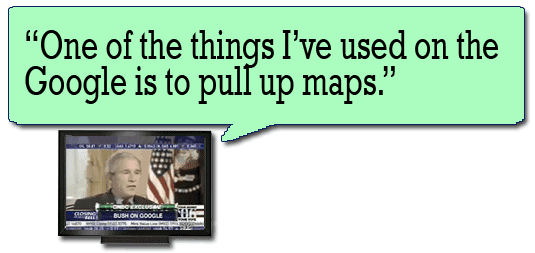
6. George W. Bush, president of the United States:
Googleosity:1,480,000* Quote type: Political blather.
Why it’s notable: The leader of the free world was famously tongue-tied–and hey, he told Bartiromo he used “the Google” only “occasionally.” Whether he misspoke or didn’t know what the world’s favorite search engine was called, his fumble has been intentionally repeated countless times by others in the three years since he made it.
*This number probably overstates this quote’s Googleosity–sadly, the Google makes it hard to form a query that accurately captures references to Bush’s gaffe.
Why it’s notable: Steiner’s cartoon–whose caption is endlessly riffed upon to this day, often by folks who probably can’t identify where it came from–neatly summarizes the democratizing effect of the Internet. In retrospect, it’s amazing that it did it sixteen years ago–before Netscape, before Yahoo, and before many Americans had ever logged onto the Net at all.
4. Elwood Edwards, husband of an early AOL employee:
Circumstances of origin: Recorded in 1989 on a cassette recorder; debuted with AOL 1.0 in 1989.
Why it’s notable: Edwards, a broadcast-industry veteran and husband of an early America Online
employee, is the voice behind the three words that have been heard billions of times by millions of people over the past twenty years. (He was also responsible for the less iconic “Welcome,” and “Goodbye,” and “File’s done!”) “You’ve got mail!” is as emblematic of AOL as the surging sea of demo disks it once pelted us with; it was made into a movie and continues to serve as the inspiration for maybe half of all headlines relating to AOL. In short, it’s hard to imagine AOL without it.
3. George W. Bush, president of the United States:
Googleosity: 2,400,000 Quote type: Political blather.
Circumstances of origin: Uttered by the 43rd president during a presidential debate on October 8th, 2004. He also referred to “the Internets” during a debate on October 17th, 2000 and in an interview on May 2nd, 2007.
Why it’s notable: It may have been a simple slip of the tongue–okay, one made repeatedly over the course of years–but “the Internets” and its variant, “the Interwebs,” have transcended simple memehood. On much of the Internet, the terms are used in discussion of Internet-related matters that isn’t otherwise particularly wacky. I wonder if the former president knows he gave the Net this little gift, and if so, what he makes of it?
2. Al Gore, vice president of the United States:
Googleosity:3,490,000 Quote type: Political blather.
Circumstances of origin: During an interview on CNN’s Late Edition with Wolf Blitzer, March 9th, 1999.
Why it’s notable: Want to take a convenient cheap shot at the 45th vice president of the United States ? Join the untold legions who have accused him of having claimed to be the inventor of the Internet. Hoax-debunking site Snopes.com says that Gore “did not claim he ‘invented’ the Internet, nor did he say anything that could reasonably be interpreted that way.” Well, maybe–taken literally, Gore’s words do seem to say that he was a co-creator of the Internet, at least. (Originally known as ARPANET, the Internet went online in October 1969, when Gore was a recent college graduate.) As a Congressman and Senator, the famously tech-savvy Gore did play a major role in communications policy; if he had said he’d been instrumental in “developing” or “expanding” the Net rather than “creating” it, his statement would have unassailable–and it wouldn’t be in this article.
1. An intergalactic villain in Zero Wing, a 1991 videogame:
Circumstances of origin: It’s a piece of threatening dialog in the European edition of a Japanese game for Sega’s Mega Drive (aka Genesis) game console. Wikipedia helpfully provides the following improved translation: “With the help of the Federation Government forces, CATS has taken all of your bases.”
Why it’s notable: Beginning in early 2001, it became the most pervasive Internet meme this side of Rickrolling. It continues to flourish, spawning thousands of variants in discussions of everything from politics to public utilities to sports. Most of the people who riff on it can presumably tell you it originated in a game. But the percentage who can tell you which game–let alone who have actually seen it–is probably minuscule.
Any nominations of notable quotes I failed to include here–including ones that deserve to be better known than they are?
You might want to have a look at how search optimization sucks, click here.
To subscribe to the "Guy WhoSteals" feed, click here.
You can add yourself to the GuyWhoSteals fanpage on Facebook or follow GuyWhoSteals on Twitter.
We need as many Reddits we can get. To Reddit this post, click on the Reddit button to the right. To Digg this post, click on the Digg button on the right or use the Share button in the Wibiya bar.
Sweet holy Buddha, is this really the future that Mark Zuckerberg is damning us to? Below is a screen shot from the big Facebook announcement today, snipped from a slideshow on Huffington Post along with the not-at-all-hyperbolic front page headline (above) declaring that this clusterfuck of ugly fonts and colors is “the way the future should work.”
Dear friends, I beg of you — look down at that page of horrors at the end of this post, and then ask yourself: Really? Can this really be true? Is there really anyone in the entire world who finds this user interface to be attractive?
After all the work I’ve done? After four decades of my Bauhaus-inspired radical minimalism and easy-on-the-eyes simplicity, this nightmare of buttons and icons and random colors, this messy electronic ransom note — this is the future? Do you have any idea how many hours, how many full days and weeks, that I’ve spent agonizing over the amount of white space that should be put at the edge of a screen? How many sleepless nights I’ve spent tossing and turning, my mind racing with decisions about type faces and kerning? And bezels and chamfers?
And now this. This world of shit and poor taste is where half a billion people choose to spend their time.
I look at Facebook and I feel the way I imagine I.M. Pei must feel when he looks at some giant public housing project. You just sit there going, Why? Why do this? Why make it so ugly when for just a tiny bit more effort you could make it, if not beautiful, at least not horrific?
I look at this page and I feel a migraine starting to come on. I feel dizzy, and get tunnel vision, and I have to go sit down on the floor in the child pose and just clear my mind.
It hurts me. Do you understand? It physically friggin hurts.
But this, we are told, is the future of messaging. All of these feeds (IMs, SMS, email) streamed into one giant steaming mountain of crap. Dear friends, this isn’t a product. It’s a punishment. But apparently there is nothing that any of us can do to stop it.
Microsoft's much-hallowed search engine, Bing, which was launched after Microsoft CEO Steve Balmer vowed to "f*cking kill Google", is a bit.... limited, shall we say. Apart from the availability and reliability issues that are so characteristic for Microsoft (the page to submit a site frequently comes up as "not available, please reload"), there is one thing strangely absent from Bing's list of countries to search in: /the entire continent of Africa is missing/! Bing places South African customers in the UK and there's no way to change that. Are they mad?
Well, that should help South African companies to be listed as relevant search hits. :-(
Wake up, Microsoft! Oh, and if you need me, I'll be on Google...
Update: I have complained about it, but don't get your hopes up...