“And I always find, yeah, I always find somethin’ wrong
You been puttin’ up with my sh*! just way too long
I’m so gifted at findin’ what I don’t like the most
So I think it’s time for us to have a toast
Let’s have a toast for the douchebags,
Let’s have a toast for the a**holes,
Let’s have a toast for the scumbags,
Every one of them that I know
Let’s have a toast for the jerkoffs
That’ll never take work off
Baby, I got a plan
Run away fast as you can”
–Kanye West
In high tech, intelligence is always a critical element in any employee, because what we do is difficult and complex and the competitors are filled with extremely smart people. However, intelligence is not the only important quality. Being effective in a company also means working hard, being reliable, and being an excellent member of the team.
When I was a CEO, this was one of the most difficult lessons for me to learn. I felt that it was my job to create an environment where brilliant people of all backgrounds, personality types, and work styles would thrive. And I was right. That was my job. Companies where people with diverse backgrounds and work-styles can succeed have significant advantages in recruiting and retaining top talent over those that don’t. Still, you can take it too far. And I did.
Here are three examples of the smartest people in the company being the worst employees.
Example 1: The Heretic
Any sizable company produces some number of strategies, projects, processes, promotions, and other activities that don’t make sense. No large organization achieves perfection. As a result, a company needs lots of smart, super engaged employees who can identify its particular weaknesses and help it improve them.
However, sometimes really smart employees develop agendas other than improving the company. Rather than identifying weaknesses, so that he can fix them, he looks for faults to build his case. Specifically, he builds his case that the company is hopeless and run by a bunch of morons. The smarter the employee, the more destructive this type of behavior can be. Simply put, it takes a really smart person to be maximally destructive, because otherwise nobody else will listen to him.
Why would a smart person try to destroy the company that he works for? There are actually many reasons. Here are few:
1. He is disempowered—She feels that she cannot access the people in charge and, as a result, complaining is her only vehicle to get the truth out.
2. He is fundamentally a rebel—She will not be happy unless she is rebelling; this can be a deep personality trait. Sometimes these people actually make better CEOs than employees.
3. He is immature and naïve—She cannot comprehend that the people running the company do not know every minute detail of the operation and therefore they are complicit in everything that’s broken.
Often, it’s very difficult to turn these kinds of cases around. Once an employee takes a public stance, the social pressure for him to be consistent is enormous. If he tells 50 of his closest friends that the CEO is the stupidest person on the planet, then reversing that position will cost him a great amount of credibility the next time he complains. Most people are not willing to take the credibility hit.
Example 2: The Flake
Some brilliant people can be totally unreliable. At Opsware, we once hired an unequivocal genius—I’ll call him Roger (not his real name). Roger was an engineer in an area of the product where a typical new hire would take 3 months to become fully productive. Roger came fully up to speed in two days. On his third day, we gave him a project that was scheduled to take one month. Roger completed the project in 3 days with nearly flawless quality. More specifically, he completed the project in 72 hours. 72 non-stop hours: No stops, no sleep, no nothing but coding. In his first quarter on the job, he was the best employee that we had and we immediately promoted him.
Then Roger changed. He would miss days of work without calling in. Then he would miss weeks of work. When he finally showed up, he apologized profusely, but the behavior didn’t stop. His work product also degraded. He became sloppy and unfocused. I could not understand how such a stellar employee could go so haywire. His manager wanted to fire him, because the team could no longer count on Roger for anything. I resisted. I knew that the genius was still in him and I wanted us to find it. We never did. It turns out that Roger was bi-polar and had two significant drug problems: 1. He did not like taking his bi-polar medication and 2. He was addicted to cocaine. Ultimately, we had to fire Roger, but even now, it pains me to think about what might have been.
One need not be bi-polar to be a flake, but flakey behavior often has a seriously problematic root cause. Causes range from self-destructive streaks to drug habits to moonlighting for other employers. A company is a team effort and, no matter how high an employee’s potential, you cannot get value from him unless he does his work in a manner in which he can be relied upon.
Example 3: The Jerk
This particular smart-bad-employee type can occur anywhere in the organization, but is most destructive at the executive level. Most executives can be pricks, dicks, a-holes or a variety of other profane adjectives at times. Being dramatically impolite can be used to improve clarity or emphasize an important lesson. That’s not the behavior that I am talking about.
When used consistently, asinine behavior can be crippling. As a company grows, its biggest challenge always becomes communication. Keeping a huge number of people on the same page executing the same goals is never easy. If a member of your staff is a raging jerk, it may be impossible. Some people are so belligerent in their communication style that people just stop talking when they are in the room. If every time anyone brings up an issue with the marketing organization, the VP of marketing jumps down their throat, then guess what topic will never come up? This behavior can become so bad that nobody brings up any topic when the jerk is in the room. As a result, communication across the executive staff breaks down and the entire company slowly degenerates. Note that this only happens if the jerk in question is unquestionably brilliant. Otherwise, nobody will care when she attacks them. The bite only has impact if it comes from a big dog. If one of your big dogs destroys communication on your staff, you need to send her to the pound.
When do you hold the bus?
The great football coach John Madden was once asked whether or not he would tolerate a player like Terrell Owens on his team. Owens was both one of the most talented players in the game and one of the biggest jerks. Madden answered: “If you hold the bus for everyone on the team, then you’ll be so late that you’ll miss the game, so you can’t do that. The bus must leave on time. However, sometimes you’ll have a player that’s so good that you hold the bus for him, but only him.”
Phil Jackson, the basketball coach who has won the most NBA championships, was once asked about his famously flakey superstar Dennis Rodman: “Since Dennis Rodman is allowed to miss practice, does this mean other star players like Michael Jordan and Scottie Pippen can miss practice too?” Jackson replied: “Of course not. There is only room for one Dennis Rodman on this team. In fact, you really can only have a very few Dennis Rodmans in society as a whole; otherwise, we would degenerate into anarchy.”
You may find yourself with an employee who fits one of the above descriptions, but nonetheless makes a massive positive contribution to the company. You may decide that you will personally mitigate the employee’s negative attributes and keep them from polluting the overall company culture. That’s fine, but remember: you can only hold the bus for her.
Intel Codenamed "Sandy Bridge," Intel's new lineup of microchips promises the biggest-ever leap in processing power.
Intel has packed just shy of a billion transistors into the 216 square millimeters of silicon that compose its latest chip, each one far, far thinner than a sliver of human hair.
But this mind-blowing feat of engineering doesn't really surprise us, right? After all, that's just Moore's Law in action … isn't it?
In 1965, an article in "Electronics" magazine by Gordon Moore, the future founder of chip juggernaut Intel, predicted that computer processing power would double roughly every 18 months. Or maybe he said 12 months. Or was it 24 months? Actually, nowhere in the article did Moore actually spell out that famous declaration, nor does the word "law" even appear in the article at all.
Yet the idea has proved remarkably resilient over time, entering the public zeitgeist and lodging hold like a tick on dog -- or maybe a stubborn computer virus you just can't eradicate. But does it hold true? Strangely, that seems to depend more than anything on who you ask.
"Yes, it still matters, and yes we're still tracking it," said Mark Bohr, Intel senior fellow and director of process architecture and integration. The company is certainly one reason Moore's Law has remained in the public's mind: A section on Intel's website details the law, explaining that "his prediction, popularly known as Moore's Law, states that the number of transistors on a chip will double about every two years. Intel has kept that pace for over 40 years, providing more functions on a chip at significantly lower cost per function."
Bohr told FoxNews.com that doubling the number of chips is far less important these days than making them smaller, which has other tangible benefits for consumers.
"The true benefit is to reduce the transistor size, because when they're smaller, you improve performance, reduce the power use, and you reduce the cost," he explained.
While no one questions the innovations Intel, AMD and other companies have brought to computers through their infinitesimally small transistors -- a human red blood cell is about 4,000 nanometers in diameter, 125 times larger than the smallest parts in Intel's new chips -- many industry experts are less certain that Moore's so-called law is really an accurate representation of the industry.
"Moore’s law isn’t tracking exactly, but the spirit of the law is still alive in that the dies are still shrinking, and CPUs become more and more capable every 12-18 months or so," said Joel Santo Domingo, lead analyst, desktops at PCMag.com. His former boss agrees.
"I did the math, and while it’s not exactly doubling every two years, it’s pretty close," agreed Michael Miller, the award-winning math geek and former editor in chief of PCMag.com.
Maybe, as Johnny Depp said in the Pirates of the Caribbean movies, it's really more of guideline?
"Semiconductor chips haven't actually tracked the progress predicted by Moore's law for many years," said Tom Halfhill, the well respected chip analyst with industry bible the Microprocessor Report.
Halfhill is quick to note that Moore's law isn't truly a scientific law, merely "an astute observation." In fact, since Gordon Moore made his observation in '65, the law has been modified and manipulated to fit the actual progress of semiconductors to such an extent that it can arguably be said to have predicted nothing.
It's also been so frequently misused that Halfhill was forced to define Moron's Law, which states that "the number of ignorant references to Moore's Law doubles every 12 months."
Halfhill wrote a paper for "The Microprocessor Report," published in December of 2004, which debunked the connection between Moore's Law and reality. In it, he noted that Moore's Law was more like Bode's law, an observation by early astronomers that each planet in our solar system is roughly twice as far from the sun as the planet in the next inner orbit.
"Modern astronomers don't expect the distances between planets to add up exactly, and they don’t expect other solar systems to conform to the same rules," Halfhill explained. Likewise, engineers don't really require the latest generation of computer chips to exactly meet Moore's Law either.
In fact, to make it track more closely to actual transistor counts, he proposed Epstein's amendment, named after a fellow editor at "The Microprocessor Report," which adds a leveling factor that accounts for the law of diminishing returns.
Halfhill is quick to point out that the Law is meaningless -- but the idea that computing keeps relentlessly advancing, that's what's really important. "Whether it's exactly as fast as Moore predicted isn't really relevant. No one's holding him to the numbers," Halfhill told FoxNews.com. What's more important is that innovation continues. And at the end of the day, if the law drives innovation, and we end up with faster PCs, who cares whether Gordon Moore was right 45 years ago?
"Moore law is almost whatever you want to make it mean. And as long as chips keep getting faster, that's good enough for most people."
Sequels have become quite commonplace in today's gaming market. Walk into a game store, and everywhere will be the number "2", with "3", "4" and "13" also making occasional appearances. Thinking up a new intellectual property (IP) is hard work, but it's easy to just slap a number and perhaps a snazzy subtitle on the end of your game's name, tweak the graphics and add a new feature or two, right? Actually, no.
Have a look at GameRankings. You will notice that the majority of sequels attain a lower average score than their predecessors. Reviewers generally think they are making these reasons perfectly clear: "A lack of innovation in the franchise". But that's not always the case. We tend to judge a sequel by much higher standards than we do a new IP, because if it looks and feels like the previous game in the franchise, in our eyes, it may as well be the previous game in the franchise. So what, exactly, causes the sometimes-fatal disease known as "Sequelitis"? Let's use some examples and have a look. I'll be using GameRankings, as it includes a large number of reviews. And just because standards do change over time, and we reviewers can be slightly random at times, I will only be including games where the discrepancy is more than 4%.
But first, a brief word about the whole "did not evolve" thing. I think it's really just a line reviewers use when they want to reduce a sequel's score, but aren't quite sure why. TakeAssassin's Creed as an example.
Assassin's Creed II (PS3): 90.47% Assassin's Creed: Brotherhood (PS3): 91.50%
This doesn't count as breaking the 4% rule, because review scores favour old games, and yetBrotherhood attained a higher score than its (fantastic) predecessor. Brotherhood has evolved less than the large majority of games panned for being "too similar" to their predecessors. Actually, Brotherhood got this comment as well, but it doesn't seem to have affected reviews very much. Anyway, without further ado, the five lessons:
Lesson 1 - Don't Take Six Years to Make Your Sequel Gran Turismo 4: 89.61% Gran Turismo 5: 84.69%
When you take six years to make a game, it had better be the pinnacle of game design. Every time you delay a game, your customers grow impatient and begin to think "This had BETTER be good". Yes, GT5 was an enjoyable racing game when it arrived, but it wasn't the brilliant, awe-inspiring game that we were expecting. This doesn't only apply to sequels, but people's expectations for the GT franchise are already extremely high, and six years of development just added to that. As such, this isn't as much of an issue for sequels to mediocre games.
Lesson 2 - Don't Re-Use the Same Engine Over and Over Again Fallout 3 (X360): 92.79% Fallout: New Vegas (X360): 83.64%
The Gamebryo engine has been in use for four years now, and New Vegas is exactly why it needs to be retired. When you try to cram a new game into an old engine, it is going to be a mess. New Vegas is considered one of the buggiest (good) games of this generation. Fortunately, Bethesda has already learnt its mistake, and The Elder Scrolls V: Skyrim is using a brand new engine. Oh, and while we're on this point, don't let another developer use your engine. Ever.
Lesson 3 - Try Not to Lose Your Lead Designer BioShock (X360): 94.95% BioShock 2 (X360): 87.89%
AND a more extreme example:
Devil May Cry: 92.60% Devil May Cry 2: 73.61%
Don't get me wrong; I enjoyed BioShock 2 very much. It was entertaining and pretty brutal, in a good way. But without the artistic genius of Ken Levine, well, it felt like it was missing something. A heart. A reason why we should care about any of the characters, or the story. I have no idea how he does it, but he does it pretty darn well. I've heard it argued that this is one of those "did not evolve" games, but I don't quite agree with that. A range of new plasmids and tonics, new weapons, a new setting, and the whole Big Daddy gameplay on top of that. Pretty much the same was true for DMC2. Mikami had little input in the development of DMC2, and it ended up being decidedly average. This one only really works if the original was a good game, which is not a prerequisite for making a good sequel (as we'll see later)
Lesson 4: Don't Get Rid of What People Loved in the Original Star Wars: The Force Unleashed (X360): 73.88% Star Wars: The Force Unleashed II (X360): 64.19%
The Force Unleashed wasn't exactly the pinnacle of game design when it launched, but it had one thing going for it: story. Really, everything else sucked, except for, arguably, Force Push and Force Throw. Nobody is denying that TFU II is a much more polished game and that it's better designed to boot. I'm also sure that nobody would deny Revenge of the Sith has better special effects than Empire Strikes Back. And yet, the latter is a better film, and TFU is a better game. Story is more important to a film than a game, but Star Wars is Star Wars, and if the story isn't good, you can't enjoy the rest of it. It was the saving grace of the original and the killing blow to the sequel. Just look at the "good ending". Come ON.
Lesson 5: Don't "Evolve" Too Much Command &Conquer 3: Tiberium Wars (PC): 85.45% Command &Conquer 4: Tiberian Twilight (PC): 63.97%
This is perhaps one of the worst sequels ever. When you have a long-running, well-loved and well-received RTS series centred around base building, the last thing you want to do is "evolve" and get rid of it completely. If you change from your predecessor too much, you lose any connection with it, and fans of the old game will not be fans of the new. And with this, I think we can hammer the final nail into the coffin of the "games must evolve" theory.
But enough negativity and broken dreams. Let's take a look at some genuinely improved sequels, and see if the five criteria apply.
Prime Example 1 Uncharted: Drake's Fortune: 89.70% Uncharted 2: Among Thieves: 96.41%, Several Game of the Year awards.
This will be the least improved sequel on this list, because Drake's Fortune was actually a great game in its own right. But Naughty Dog stepped up to the plate and delivered an incredible experience.
1) This took only two years to make; nowhere near six.
2) Two years, and they still improved the engine. It was also developed in-house, so Naughty Dog knew how to use it.
3) Amy Hennig was the Director of Drake's Fortune, and though her job was split up forAmong Thieves, she remained Creative Director.
4) Beautiful environments? Improved. Brilliant characters, dialogue and story? Improved. Actually, this calls for a new lesson.
5) It still felt like the original Drake's Fortune at heart, just a much more polished version.
Lesson 6 - Improve Everything.
This might sound like a given, but very few games actually do it. You might think "it's okay, we'll leave this as it is", which will mean that, at best, it will be as good as before, or even worse, "We'll improve this by making this other thing worse", which is exactly how we ended up with Force Unleashed II. If you leave something unimproved, it will come back to bite you.
Prime Example 2 Assassin's Creed (PS3): 78.82% Assassin's Creed II (PS3): 90.47%
There was far more room for improvement here, because Assassin's Creedwasn't particularly good. The criteria:
1) Again, two years.
2) Fine, the same engine here, but look at how beautiful Assassin's Creed was to begin with. These rules aren't necessarily set in stone. And again, two years, and an in-house development engine.
3) I said that this wasn't a requirements for sequels to average games, but they still kept Patrice Desilets. The ideas behind AC1 were good; just not the execution.
4) What did people love in the original? Viewpoints? Better than ever. Assassinations? Far more frequent, and without the absurd monologues and menial side-missions that accompanied them. Platforming? Still there in huge quantities.
5) Even though it did improve everything, anyone playing ACII could tell that it was a sequel toAC, and no fans of AC would be alienated.
6) Combat was improved. Story and characterisation were massively improved, as was sound. Even the already-solid platforming was improved.
Prime Example 3 Killzone: 73.92% Killzone 2: 90.07%
As with Assassin's Creed II, there was plenty of room for improvement, and Guerilla did a fantastic job.
1) Four and a half years, but it was a new platform, and the game did actually live up to expectations, and exceed many, because its predecessor was so mediocre.
2) It would probably be a cause for concern if Guerilla used the same engine on two platforms, so it's good that they didn't.
3) Nobody actually seems to know who directed Killzone, but Mathijs de Jonge did a fantastic job outdoing them.
4) This didn't actually happen, but Killzone 2 was never really marketed to the Killzoneaudience.
5) Pretty much the same as 4)
6) Everything certainly was improved, from the graphics, to the sound, to the gunplay.
Killzone 2, then, is a special case. You can, in extreme circumstances, just pretend that the original never existed, and go from there. This is an option when you expect the sequel to be FAR better, and when the original wasn't very popular to begin with, so there is no risk of alienation. Your game had also better be pretty awesome, so even the fans of the original will see some new charm here.
So, there we have the six criteria that seem to fit most games. Again: 1) Don't spend too much time on development. 2) Change your engine every so often, and if you can, use one that you've developed yourself. 3) Try to keep the team the same, especially if the original was good. 4) Don't get rid of the parts of the original that people loved. 5) Don't try to evolve too much and forget what made the original great. 6) Improve everything, because one bad aspect can bring the whole game crashing down.
Writing, whether it appeared in print or on a blog, was dissected, critiqued, relinked and shared faster than ever in 2010. Just take a look at the recent arguments on the Lamo/Manning Wikileaks chat logs between Salon's Glenn Greenwald and Wired's Kevin Poulsen that have spilled out from traditional columns to Twitter and back again. A New Yorker article from Malcolm Gladwell kicked off an Internet-wide debate on the efficacy of social activism through social networking, and discussion of the Internet's attack on our and ever-dwindling attentionspans raged all year long. We took a look back at this year's most notable, controversial and challenging tech articles, picked some of our favorites and broke down the rest by privacy, entertainment, life and the Web, Web culture, people, business and gadgets. Fire up Instapaper or your favorite reading app and enjoy!
Top 15
Zadie Smith - Generation Why - The New York Review of Books
From the opening scene it's clear that this is a movie about 2.0 people made by 1.0 people (Aaron Sorkin and David Fincher, forty-nine and forty-eight respectively). It's a talkie, for goodness' sake, with as many words per minute as His Girl Friday. A boy, Mark, and his girl, Erica, sit at a little table in a Harvard bar, zinging each other, in that relentless Sorkin style made famous by The West Wing (though at no point does either party say "Walk with me"-for this we should be grateful).
Facebook activism succeeds not by motivating people to make a real sacrifice but by motivating them to do the things that people do when they are not motivated enough to make a real sacrifice. We are a long way from the lunch counters of Greensboro.
We never imagined that artificial intelligence would be like this. We imagined discrete entities. Genies. We also seldom imagined (in spite of ample evidence) that emergent technologies would leave legislation in the dust, yet they do. In a world characterized by technologically driven change, we necessarily legislate after the fact, perpetually scrambling to catch up, while the core architectures of the future, increasingly, are erected by entities like Google.
Gonzalez was debriefed and soon found to be a rare catch. Not only did he have data on millions of card accounts stored on the computer back in his New Jersey apartment, but he also had a knack for patiently explaining his expertise in online card fraud. As one former Secret Service agent told me, Gonzalez was extremely intelligent. "He knew computers. He knew fraud. He was good."
A definitive understanding of what really happened is virtually impossible to acquire, largely because almost everything that is known comes from a single, extremely untrustworthy source: Lamo himself.
Julian Assange, in defending his actions sees a vindicating contradiction in this difference: How can information be both dangerous and inconsequential, he asks? He sees information as an abstract free-standing thing, so to him, differences in perspective and circumstance mean nothing. This is how nerd supremacists think.
A closer look at these matters brings us to the real value of WikiLeaks. Over and above their oft-stated goal of scaring the bejesus out of any would-be misbehaving varmints in power is an even simpler and more valuable message for the public: don't believe anything you read. No seriously, not one single thing.
Following doesn't mean paying attention. You don't want numbers on Twitter, not really. What you want is to follow and be followed by human beings who care about issues you care about.
This, Wolfram says, is the deep challenge of artificial intelligence: a lot of human knowledge isn't represented in words alone, and a computer won't learn that stuff just by encoding English language texts, as Watson does. The only way to program a computer to do this type of mathematical reasoning might be to do precisely what Ferrucci doesn't want to do - sit down and slowly teach it about the world, one fact at a time.
The next 40 years will bring us some wonderful things. I don't mean to imply they're all to be avoided. Alcohol is a dangerous drug, but I'd rather live in a world with wine than one without. Most people can coexist with alcohol; but you have to be careful. More things we like will mean more things we have to be careful about.
"Their brains are rewarded not for staying on task but for jumping to the next thing," said Michael Rich, an associate professor at Harvard Medical School and executive director of the Center on Media and Child Health in Boston. And the effects could linger: "The worry is we're raising a generation of kids in front of screens whose brains are going to be wired differently."
I feel like flow is ascendant these days, for obvious reasons-but we neglect stock at our own peril. I mean that both in terms of the health of an audience and, like, the health of a soul. Flow is a treadmill, and you can't spend all of your time running on the treadmill. Well, you can. But then one day you'll get off and look around and go: Oh man. I've got nothing here.
At one point I realized that I was drifting into trouble in a game against one of the "Kasparov" brand models. If this machine scored a win or even a draw, people would be quick to say that I had thrown the game to get PR for the company, so I had to intensify my efforts. Eventually I found a way to trick the machine with a sacrifice it should have refused. From the human perspective, or at least from my perspective, those were the good old days of man vs. machine chess.
Even over the few days I spent developing Cow Clicker, I found myself watching people play, listening to feedback, and imagining changes. I "listened to my players" and made enhancements far beyond what was reasonable for a work of carpentry or a simple parody. It's hard for me to express the compulsion and self-loathing that have accompanied the apparently trivial creation of this little theory-cum-parody game.
Without further ado, let's get to the 800-pound gorilla of the bunch, the iPad. The device's unimaginative name belies its sleek, creative design, which is everything we've come to expect from Apple. It's pretty to look at, and they've worked out a lot of the touch-screen kinks that plagued the iPhone and iPod Touch. It's also much smaller and lighter than a laptop, making it easy to tuck under a fin when you're swimming out the gate, and thanks to Apple's dominance in the smartphone field, there will be thousands of applications for it.
He'd betrayed the Secret Service and cost U.S. companies and credit card users big money. TJX alone lost 46.5 million credit card numbers and spent more than $132 million paying back customers, fixing security flaws, and defending itself in lawsuits. Banks, retailers, and payroll companies racked up "hundreds of millions" in expenses, prosecutors said.
Given Obama's reputation as a our most tech-savvy president to date, and one whose election was due, in part, to online organizing, Malamud is betting that he can get this administration to see the wisdom in open-source government. His success or failure will speak volumes about whether Washington will reap the benefits of the Internet age -- or whether the current celebration of technology culture will simply fade away.
The two feeds are co-written anonymously by former Observer staffers Peter Stevenson and Jim Windolf, and although their semi-private joke has lately started going public-the Village Voice not long ago alluded playfully to Wise and Cranky; New York Magazine's "approval matrix" dubbed the latter "brilliant" and "lowbrow"-the two accounts are still essentially undiscovered. They shouldn't be. Whether one has a table at Elaine's or a stool in the local dive bar (or both), the Kaplan dispatches offer one of the most entertaining and ambitious uses of Twitter yet.
Video games and cocaine feed on my impulsiveness, reinforce my love of solitude and make me feel good and bad in equal measure. The crucial difference is that I believe in what video games want to give me, while the bequest of cocaine is one I loathe. I do know that video games have enriched my life. Of that I have no doubt. They have also done damage to my life. Of that I have no doubt. I let this happen, of course; I even helped the process along. As for cocaine, it has been a long time since I last did it, but not as long as I would like.
Chewbacca didn't spring to life out of nowhere, fully formed when Lucas saw his dog in the passenger seat of his car. That's the soundbite. A single step. The reality is complex and human. From vague names floating around, the kernel of an idea, changing purposes and roles of characters, major restructuring, the design hopping from person to person, scrapping the existing concept and going down a different path, seeing existing things in a different light and having to conform a range of ideas to complement and enrich one another.
But seriously, the music industry was the first to get hit in the switch to digital, that I can think of. Everyone at the top resisted. They couldn't see their industry going away, not after windfalls a few years prior. Even the studios couldn't imagine that they wouldn't be needed as much, seeing as it took so much money to record an album. Technology changed that.
Adler's idea that we can - and should - defend ourselves against the imposed generalities of official knowledge is typical of pioneering self-trackers, and it shows how closely the dream of a quantified self resembles therapeutic ideas of self-actualization, even as its methods are startlingly different.
Is creating cultural products always more generous, more communally valuable, than consuming them? And why, in this context, would TV-watching be any different from that quintessentially introverted practice that is reading a book?
What concerns me about the literary apocalypse that everybody now expects-the at least partial elimination of paper books in favor of digital alternatives-is not chiefly the books themselves, but the bookshelf. My fear is for the eclectic, personal collections that we bookish people assemble over the course of our lives, as well as for their grander, public step-siblings. I fear for our memory theaters.
This is not obviously something completely exclusive to the Internet. We've all had the experience of stepping out of a car and suddenly realizing, "Wait, I just drove all the way home and have no memory of doing it." But there's a very different feeling to this one; it's almost as if my brain is creating my own avatar and putting it in a space which lacks the constraints of time or much physical detail.
Here's the thing: For most of us, cyborg ends at the human-machine hybrid. The point of the cyborg is to be a cyborg; it's an end unto itself. But for Clynes, the interface between the organism and the technology was just a means, a way of enlarging the human experience. That knotty first definition? It ran under this section headline: "Cyborgs -- Frees Man to Explore." The cyborg was not less human, but more.
The new media have caught on for a reason. Knowledge is increasing exponentially; human brainpower and waking hours are not. Fortunately, the Internet and information technologies are helping us manage, search and retrieve our collective intellectual output at different scales, from Twitter and previews to e-books and online encyclopedias. Far from making us stupid, these technologies are the only things that will keep us smart.
This love/hate relationship with social networking is widespread. Ablett's experiences echo those of many others who find they simply cannot live without Facebook. To sign off from its pages is to excise yourself from social groups and invitations, to vanish from friends' lives. So we get stuck in a vicious circle, compulsively checking each other's status updates and feeling alienated as a result.
You have no time to create a social network. We work long hours, so it's really a system where we don't have time to find people for ourselves. It's taboo to date people at the work place, the social networks are weaker in the physical world. We move all the time and we don't have a yentl or parents to tell us what to do
Attention spans evolve and shorten, as even the most skilled media jugglers can attest. "I love the iPad," admits Mr. Negroponte, "but my ability to read any long-form narrative has more or less disappeared, as I am constantly tempted to check e-mail, look up words or click through." And people, every bit as much as technology, shape the churning media ecology.
David King, a YouTube product manager, told me that the system can find extremely fuzzy matches. It can spot when a copyrighted video has been transformed in some way by an uploader-for instance, it can finger a basketball game even if you pause, rewind, and then replay a clip from it, and it can identify Eric Cartman if you record a clip of South Park by holding your camera up to your TV.
Olia Lialina - Prof. Dr. Style - Contemporary Home Computing
Primitivity tells us the story of the browser being not only a browser, but also an editor. Every user of the early web was a producer of web content. Web pages were to be opened in the browser to look at them, but also to edit them, using existing pages as templates for new pages. The simple design of HTML made it possible for the first users to create state of the art pages with only four to five principal tags. The result was an extremely fast growing web. There were not many options, this is why we got many pages.
Zuckerberg's ultimate goal is to create, and dominate, a different kind of Internet. Google and other search engines may index the Web, but, he says, "most of the information that we care about is things that are in our heads, right? And that's not out there to be indexed, right?" Zuckerberg was in middle school when Google launched, and he seems to have a deep desire to build something that moves beyond it. "It's like hardwired into us in a deeper way: you really want to know what's going on with the people around you," he said.
Maureen Tkacik - Look at Me! - Columbia Journalism Review
What I'm talking about is, of course, a lot easier to do with the creative liberties afforded a blog-one's humanity is inescapable when one commits to blogging all day for a living. I don't think it's a coincidence that Andrew Sullivan, one of journalism's preeminent blogging brands, is one of very few journalists to have endured his own sordid sex scandal.
It's no exaggeration to say that technology has subverted the original idea of America. The founders explicitly rejected direct democracy - in which citizens vote on every issue - in favor of representative democracy. The idea was that legislators would convene at a safe remove from voters and, thus insulated from the din of narrow interests and widespread but ephemeral passions, do what was in the long-term interest of their constituents and of the nation. Now information technology has stripped away the insulation that physical distance provided back when information couldn't travel faster than a horse.
It actually wasn't until late May, after the ninth Foxconn employee had leaped to his death, that Foxconn went into full crisis management mode, stringing more than 3 million square meters of yellow-mesh netting around its buildings to catch jumpers and setting up a 24-hour counseling center staffed by 100 trained workers.
In Brin's way of thinking, each of our lives is a potential contribution to scientific insight. We all go about our days, making choices, eating things, taking medications, doing things-generating what is inelegantly called data exhaust. A century ago, of course, it would have been impossible to actually capture this information, particularly without a specific hypothesis to guide a researcher in what to look for. Not so today. With contemporary computing power, that data can be tracked and analyzed. "Any experience that we have or drug that we may take, all those things are individual pieces of information," Brin says. "Individually, they're worthless, they're anecdotal. But taken together they can be very powerful."
These ideas about the power of our company culture had yet to be proved. As I talked to Amazon founder and CEO Jeff Bezos, who visited our headquarters in 2005, I realized that to Amazon, we were just a leading shoe company. If we sold, we'd probably be folded into their operations, and our brand and culture would be at risk of disappearing. That was why we told Jeff that we weren't interested in selling at any price. I felt like we were just getting started.
Is that all social media is doing? Playing psychological video games in ways that form habits and drive revenue for Internet companies? Ashvin says no. And he points to Quora as an example of why this isn't the case. Quora actually does make you feel optimistic. It's a thingy that is meant to harness the collective knowledge of all the smart people who use the Internet and get them to answer human questions and provide nuanced human answers.
[L]et's call this thing what it is. It's the mother of all value-adds to the biggest audience of all: the screwing-around-at-work network. The entire Internet economy is built on simultaneously enhancing and destroying workplace productivity, and now that's going to a WHOLE new level.
Which brings me up to today. With my Curve lost somewhere between my hotel and San Francisco airport, a major industry question suddenly became very personal: a year and a half after buying the 8530, was there really no solid smartphone option in the market from RIM? Obviously, I knew the answers to that question -- I'm a tech editor after all -- but it wasn't until I saw Lazaridis speak a day later that I saw the writing on the wall for me and the company: RIM doesn't have a competitive smartphone now, nor will it have one any time in the near future.
Neither Google nor the current Android device manufacturers embody the part of Apple's culture that allows them to release a great product on day one. They have a different pattern: It's always getting better. We're always supposedly one or two releases from it being really great.
One relatively recent and very simple intervention, made possible by the lamination together of three or four different kinds of technology, has completely changed what a map is, what it means, what we can do with it. It's this: that for the very first time in human history, our maps tell us where we are on them.
Take the best of what you understand of your readership and the decade or so that many magazines have spent on the internet and look to exploit the social technologies of the web, rather than run to present your content as an isolated recapitulation of a mid-1990s CD-ROM.
The haters tend to be techies; the fans tend to be regular people. Therefore, no single write-up can serve both readerships adequately. There's but one solution: Write separate reviews for these two audiences.
A lover's e-reader just doesn't give off the same feeling of secrets and possible belonging in the way a bookshelf can. E-books will never be rare books or limited editions. It just isn't the point of an e-book.
If soon we lose even the string of numbers that separates our abstract phone-identity from our physical selves, the phone will, once again, increase its pervasiveness and omnipresence. More and more, we move ourselves into an apparatus-a communication armor, owned and provided by corporations-that can send and receive messages at all times.
As programmers, how do we go about teaching people well?
After all, coding has many of the same traits as teaching. Underneath the fancy patterns and elegant frameworks, code is just a set of concrete instructions to do something. Even if one, seemingly obvious, detail is left out, you'll know soon enough. Code has an order too. You can't implement a concept before it's been defined yet, just like you couldn't teach someone how to multiply before they understand how to add.
But, good coding isn't like teaching at all. It promotes habits that are entirely counterproductive to the art of teaching. A really good programmer just might make for an awful teacher.
First, rarely do we code linearly. You don't start from the top and just work your way down to the end of the story. Along the way, a clear concept in your head turns into a half-truth. Part way through writing a method, you might decide you need to track things in an array. After a few minutes, you'll decide a hashtable works better. If coding against a platform is at all like talking to a student, you'd sound rather unsure of yourself.
Second, coding lets you cheat on the details. We compile our code not because we think we're done, but because we want to find out what we may have missed. You can usually bucket most compiler errors in the "I was just being lazy" category. A missed instantiation here, a data-type mismatch or non-returned value there. I'm a habitual compiler. A compiler is a lazy programmer's best friend. Ditto for unit tests, code-hinting and auto-completion.
All these niceties are great for programming. They give us softly padded walls to bounce our code off of. They let us focus on the hard stuff first and not worry too much about perfection in our code-speak. A good programming platform is simultaneously wiping our chin, correcting our grammar, and telling us what we really mean while we spew out semi-coherent lines of instruction. And, the faster and more efficient we are at coding, the more we rely on the platform to steer us in the right direction.
Teaching a newbie is entirely different. Every missed detail is a lost detail. You can't start your sentences expecting your student to finish them — at least not early on. And unlike a compiler, who invariably will forget your missteps once you correct them, people don't have as much luck separating the wrong details from the right. You may compile your code a dozen times before you finally get it right, but imagine correcting yourself twelve times before your teaching lesson finally makes sense.
You, my friend, make a terrible teacher.
How do you teach people well? It starts by knowing that what may make you a great programmer will not make you a great teacher.
If you’ve done even a little programming then you’re also good at finding ways to waste time watching things vaguely related to it. Admit it, you’ve spent at least a few hours watching videos about Android’s latest features or Chrome’s Internals even though you’ll never write a single line of code for either. Don’t worry, I’m not going to list a bunch of technical talks. We’re talking entertainment for after the work day. The following movies are stimulating to watch for those with a programming oriented mind. And you know what that means, softcore porn!
Welcome to Macintosh
Netflix Streaming? Yes
Apple documentary that does a great job tracking the reasons for its successes and failures. I wasn’t sure I’d like the movie after reading the description on Netflix, but once the interview with a grumpy and inebriated ex-Apple Engineer started I was sold. Just gets better from there.
The IT Crowd
Netflix Streaming? Yes, series 1, 2, and 3. 4 is available on iTunes for ten bucks.
Lets face it, if you’ve done any programming at all then you’re also the go to IT person for your entire extended family. Over Thanksgiving I’m sure everyone one of you spent at least a few hours exercising the Tech Support Cheat Sheet. The main focus of this show quickly diverges from IT, but each episode still includes references to nerd popculture.
We Live in Public
Netflix Streaming? Yes I can’t believe I had never heard of Pseudo. If you haven’t, then make this the first movie you watch off this list. You’ll be shocked that something like this existed in the late 90’s. Also a bit of nudity sprinkled throughout, just for fun.
The Social Network
Netflix Streaming? No, not even out on DVD yet I’ll leave this description up to the awesome blogger, Mike Rundle:
“The Social Network was fucking awesome. Do not see it if you have an idea in your head because it’ll make you want to work on it 24/7.”
Hackers
Netflix Streaming? Yes I had to include it, this one is sentimental for me. It was the first movie I had seen that showed computer nerds in an enviable light and not as pariahs being put in lockers. The brief sensual scene with Angelina Jolie made this a childhood favorite.
Pirates of Silicon Valley
Netflix Streaming? No, but you can watch it on Google Video.
Yea I can’t believe that’s still around either. I’ll admit it, I’m too young to have actually been paying attention when the events of this movie were actually taking place, it gives a nice synopsis of how Microsoft and Apple ended up where they were in the late 90’s.
Revolution OS
Netflix Streaming? Yes Some nerd cred if you ever wind up trapped in the same room as an old Cobol sysadmin.
Office Space
Netflix Streaming? No
This one is last because I’d be really freaking surprised if you haven’t seen it. It will help you better understand why that creep guy in your office covets his red stapler.
That’s it! Please let me know if you have any other favorites that I did not list in the comments below. I’ll watch them, and if I get enough suggestions I’ll post a second list in the future.
Microsoft shipped Windows 1.0 on November 20th, 1985. Twenty-five years and two days later, it’s not just hard to remember an era in which Windows wasn’t everywhere–it’s also easy to forget that it wasn’t a given that it would catch on, period.
The company had announced the software in November of 1983, before most PC users had ever seen a graphical user interface or touched the input device known as a mouse. But by the time Windows finally shipped two years later, after a series of embarrassing delays, it had seemingly blown whatever first-mover advantage it might have had. At least four other major DOS add-ons that let users run multiple programs in “windows” had already arrived.
In a pattern that Microsoft would repeat with later products, though, it managed to make being late to the party work in its advantage. For one thing, Windows’ super-premature announcement left those four earlier packages competing with it even though it didn’t actually exist yet; many people sensibly postponed buying any “windowing” environment until it was clear how things would pan out.
For another, most of the developers of the earliest Windows rivals shot themselves in the foot, usually more than once: They released products that required cutting-edge machines which few people owned, or got ensnared in lawsuits, or failed to get third-party developers on board. Just as several of them were running out of steam, Windows arrived on the scene. And even though it didn’t gain traction for nearly another half a decade, that was okay; nothing else became a hit in the interim.
“Our approach is that there is only going to be one winner,” InfoWorld quoted Microsoft marketing honcho Steve “Bulmer” as saying in November of 1983, shortly after Windows was announced. The publication got his name wrong, but he couldn’t have been more right about the market.
For the purposes of this roundup of Windows rivals, I considered only environments which were designed to run on IBM-compatible PCs, and which (like pre-1995 versions of Windows) ran on top of DOS rather than replaced it. (That’s why the Mac OS and OS/2, for instance, aren’t here.) I also cover only products released in 1990 or before; once Windows 3.0 was released, Microsoft’s package became a juggernaut and attempts to compete with it largely ended.
That still leaves half-a-dozen significant Windows rivals. They may have failed to compete with Microsoft, but they were all interesting failures. And on Windows’ 25th anniversary, they deserve to be remembered.
Visi On
Publisher: VisiCorp Debuted: December 1983, a year and eleven months before Windows
Why it was better than Windows, or at least different: If pure prescience and ambition could ensure a product’s success, Visi On would have been a blockbuster. The follow-up to VisiCalc–the first spreadsheet and the young industry’s biggest hit to date–Visi On was the first full-blown windowing environment for PCs. It had a mouse-driven (although text-based rather than graphical) interface. And VisiCorp supplied a full suite of integrated apps–required, since it didn’t run DOS apps–that included Visi On Word, Visi On Calc, and Visi On Graph. People who saw early demos were reportedly so blown away that some of them thought it was running on an artfully-concealed minicomputer rather than a PC.
What the critics said: “In summary, the VisiOn system is a milestone in personal computing software. Like many other milestones, it both points the way towards the future and falls far short of it.”
–Thomas Bonoma, Softalk
The publisher called it: “a ‘boss’ who instructs the computer on how to deal with the specific applications you want to work with…Since all these applications work for the same boss, they all work the same way. Learn to use one, and you’ve essentially learned to use them all.”
What happened: What didn‘t happen? VisiCorp thought it would be able to get Visi On running on floppy-based PCs, but by the time it shipped it required 2.2MB of hard-disk space, in an era when a PC with two floppy drives was considered luxurious. Buying all the software and the mouse cost a stiff $1765. And at the same time the company was trying to get Visi On off the ground, it was beset with legal and financial woes–VisiCalc creator Software Arts was suing it, and Lotus 1-2-3 was rendering VisiCalc obsolete. Reviews of Visi On were mixed at best: InfoWorld was respectful, but pointed out that the spreadsheet was harder to use than VisiCalc and forty times slower at recalculating a large spreadsheet. In August of 1984, VisiCorp sold Visi On development rights to Control Data; three months later, it sold itself to a company called Paladin; by early 1986, weeks after Windows was released, Visi On was already effectively dead.
TopView
Publisher: IBM Debuted: February 1985, ten months before Windows 1.0 Why it was better than Windows, or at least different:TopView began as an IBM research product around 1980–before the IBM PC had reached the market. It was announced in August of 1984 at the same time as IBM’s powerful PC AT, and was intended to leverage that machine’s potent technical capabilities. (It required 512KB of RAM and two floppy drives, fairly imposing specs at the time.) Rather than requiring all-new graphical applications, TopView was designed to run DOS programs, but third-party developers could also write “TopView-aware” apps that took advantage of its advanced capabilities. Pundits wondered whether it was designed to eventually supplant DOS, making it harder for third-party PC manufacturers to compete with IBM.
What the critics said: “I was impressed by the concept and IBM’s demonstrations, but, after using the recently released product, I’m less enthusiastic.”
–Larry Magid, Los Angeles Times
The publisher called it: “[a] new kind of software program that lets you run and ‘window’ several other programs at once.”
What happened: Like Windows, TopView was announced and hyped well before it was ready. Two months after it finally hit the market, InfoWorld’s John C. Dvorak was already comparing it to the PC Jr.; few developers bothered to write TopView-aware software, configuring stock DOS apps to run with the package was notoriously tricky, and IBM reportedly sold only a few hundred copies a month. In August of 1985, Big Blue signed a deal with Microsoft to develop operating systems together, and the tech press immediately began speculating that the agreement marked the end of the road for TopView. (The IBM-Microsoft arrangement eventually led to the creation of OS/2, which shipped in December of 1987.) TopView wasn’t officially discontinued until mid-1990, but by that point just about everyone who found the idea intriguing had switched to Quarterdeck’s DESQview.
GEM
Publisher: Digital Research Debuted: February 1985, ten months before Windows 1.0
Why it was better than Windows, or at least different: By the mid-1980s, Digital Research was famous mostly as the company whose CP/M operating system was displaced in the market by Microsoft’s CP/M knockoff MS-DOS. But it got a chance to start fresh with GEM (Graphical Environment Manager). The package beat Windows to the market and looked far more like Apple’s groundbreaking Macintosh. The company also released an array of productivity apps for its environment, such as GEM WordChart; one very popular third-party app, Ventura Publisher, ran on top of a run-time edition of GEM. A modified version of GEM also served as the interface for Atari’s ST line of computers.
What the critics said: “…offers IBM PC users a Macintosh interface.”–Keith Thompson, InfoWorld The publisher called it: “…not just software. It’s a movement.”
What happened: GEM ran into trouble almost immediately; shortly after its release, Apple sued over its Mac-like look, forcing Digital Research to release a new, less elegant edition. It never managed to give Windows serious competition, but it did muddle along into the 1990s, along with Digital Research’s MS-DOS workalike DR-DOS. Novell, which bought Digital Research in 1991, thought DR-DOS had potential but didn’t do much of anything with GEM. Still, the software was open-sourced in 1999 and continues to exist, at least sort of, as FreeGEM and OpenGEM.
DESQview
Publisher: Quarterdeck Debuted: July 1985, five months before Windows 1.0
Why it was better than Windows, or at least different: DESQview was based on DESQ, an earlier Quarterdeck product, and was initially marketed as a superior alternative to IBM’s TopView. Resolutely text-based and keyboard-oriented, it allowed for efficient multitasking of DOS apps and came with QEMM, a famously well-done memory manager that was also available separately. (This was back when PC users had to obsess over the 640KB memory limit and devote energy to figuring out how to override it.) People who liked DESQview really liked it; well into the 1990s, there were folks who swore off Windows and saw it as a way to avoid the whole graphical user interface revolution.
What the critics said: “…a powerful, useful, clever windowing system.”
-Marc Stern, InfoWorld
The publisher called it: “…the recognized pioneer in DOS multitasking.”
What happened: DESQview sold only a tiny fraction as many copies as Windows did, but it was one of the few packages here that qualified, for a while, as a success. At some point, though, sticking with DOS apps and running them in DESQview went from a perfectly understandable decision to a weird affectation. (In 1990, Quarterdeck had released DESQview/X, an ambitious, all-new environment that let users use Unix-based X Window apps as well DOS and Windows apps; it was too much too late, and never threatened Windows.) By the time Quarterdeck sold out to Symantec in 1998, the DESQview era such as it was had ended. And Quarterdeck, having failed to beat Windows, had morphed into a developer of utilities for it.
DeskMate
Publisher: Tandy (that’s Radio Shack to you and me) Debuted: 1986
Why it was better than Windows, or at least different: In the 1980s, many home PCs were pretty darn rudimentary, even by then-current standards. And a lot of them were sold by Radio Shack, then a major manufacturer of cheap IBM PC clones. At a time when many PC users deemed Windows to be a resource hog they didn’t need, the company put its DeskMate text-based windowing environment on machines such as the Tandy 1000, where it was sometimes stored in ROM. DeskMate never got very pretty, but it did become the center of its own little parallel universe, with multiple upgrades (it reached version 3) and special versions of such popular programs as Lotus 1-2-3 and Quicken. It was also eventually sold in shrinkwrapped form for non-Tandy PCs, and there was an edition for Radio Shack’s TRS-80 Color Computer.
What the critics said: “For many users, especially those with little computer experience or less powerful hardware (it requires just an 8088 and a single floppy disk) Deskmate has inexpensive and has a lot to offer.” Michael J. Miller, InfoWorld
The publisher called it: “The Friendly Face in the PC Crowd(tm)”
What happened: After Windows 3.0 shipped in 1990, DOS-only PCs went into a gradual but inexorable death spiral; the arrival of Windows 1995 finished them off. At the same time, Radio Shack gradually got out of the computer business. Its 1994 catalog was the last to mention DeskMate, and the 1995 one was the last to include computers at all. The company sold its PC business to AST, leaving DeskMate as an orphan.
PC/GEOS
Publisher: Berkeley Softworks (later GeoWorks) Debuted: 1990, the same year as Windows 3.0
Why it was better than Windows, or at least different:GEOS (later known as GeoWorks Ensemble) was a graphical environment that looked and behaved much like Windows, with an interface based on Motif, a widely-used environment from the Unix world. But it was much meaner and leaner than anything from Redmond it ran just fine on supposedly obsolete hardware such as an IBM PC XT. GEOS tended to get excellent reviews. And even though it arrived at the same time that Windows 3.0 was selling like gangbusters, plenty of folks thought that the market would have room for both environments.
What the critics said: “If you can only swing a 286, GeoWorks is faster and slicker than trying to run Windows.” Sebastian Rupley, InfoWorld
The publisher called it: “…the fastest ramping graphical environment ever.”
What happened: Windows 3.0 and beyond crushed GEOS much like Godzilla crushed Bambi. But for a failed piece of software, GEOS has had a lively existence. It served as the platform for AOL’s DOS version the whole thing fit on one floppy and a pen-based version powered HP’s 1995 OmniGo palmtop; it was also bundled with Sony and NEC CD-ROM drives. Ownership of the software changed hands several times, and it’s still around as Breadbox Ensemble. Somewhere out there, people are still using it which is more than you can say about DeskMate or Visi On.
It’s not love, war, or baseball. But over the years some memorable things have been said about technology. Some have been memorably eloquent; others are unforgettably shortsighted, wrongheaded, or just plain weird. Let’s celebrate them, shall we?
A few ground rules for the list that follows: I considered only statements attributable to a specific individual, which ruled out most ad slogans (“Think Different”) and many durable Internet memes (“You are in a maze of twisty passages, all alike”). I did, however, include individuals who happened to be fictional, or canine, or inanimate. I also let a couple of quotes slip in that are not strictly speaking about technology, though neither would exist without it–one from 1876, and one from earlier this decade. Sue me.
It’s hard to rank quotes by how notable they are. So I faked it by listing them using an imprecise, unscientific factor I call Googleosity: the number of results Google reports that reference (or riff upon) each quote. (You may quibble with the queries I performed to determine Googleosity, but I tried my best.) Googleosity tends to reward quotes that are not only famous but fun–they’re the ones that people like to allude to, to parody, and to generally weave into blog posts and other online conversation.
We’ll start with the quote with the lowest Googleosity factor, and work our way up from there.
25. Mike Doonesbury’s Newton-like PDA:
Googleosity:3,970 Quote type: Satire as product evaluation.
Circumstances of origin: In Garry Trudeau’s Doonesbury strip for August 27th, 1993, as Mike tries out his new PDA’s handwriting recognition; it’s what the PDA thinks he meant when he scribbles “Catching on?”
Circumstances of origin: The statement was one of three ‘Sayings from Chairman Jobs” that Jobs shared at a January, 1983 Macintosh team retreat in Carmel, California. The groundbreaking computer was behind schedule and wouldn’t end up shipping for another year. (The other two sayings: “It’s better to be a pirate than join the Navy” and “Mac in a book by 1986.”)
Why it’s notable: Jobs was right–the technological innovations that matter most are the ones that appear in products that consumers can actually buy. Here’s a good blog post on how the “Real artists ship” ethos impacts Apple to this day.
Why it’s notable: In an industry notorious for overhype–especially for new operating systems–this modest little message is one of the most hype-free major product announcements ever. Torvalds’ “hobby” went on to change the world, in part by inspiring such other worthy open-source projects as Mozilla’s Firefox.
Why it’s notable: Former Sun CEO McNealy may be the most irritable man in technology. (He once told me I’d asked him the dumbest question he’d ever heard.) His dismissal of a question about the privacy implications of the company’s Jini platform for distributed services is shocking–in part because CEOs touting new technology usually don’t talk like that, and in part because his blanket statement is closer to being true than most of us would care to admit.
21. Ken Olsen, founder of legendary minicomputer company DEC:
Circumstances of origin: A talk to the World Future Society in Boston, presumably before an audience full of folks who disagreed with him.
Why it’s notable: Unlike the similarly shortsighted “I think there is a worldwide market for maybe five computers,” Olsen’s seemingly blithe dismissal of the home PC is definitively real. But Olsen and his defenders say he was quoted out of context–that he was talking about all-powerful computers that would control lights, temperature, entertainment, and meals. I admire the guy, so I’ll cut him some slack. Is it a coincidence, though, that when DEC attempted to enter the home computer market five years later, it was with a famously miserable machine?
Circumstances of origin: In an “open letter” dated February 3rd, 1976 and published in several computer magazines of the day.
Why it’s notable: Gates, a twenty-year-old Harvard dropout who’d started a company named “Micro-Soft” with buddy Paul Allen less than a year before, was all fired up over widespread piracy of the company’s first product, BASIC for the Altair microcomputer. The letter is Gates before he got slicked up and toned down for public consumption, although it does end on a positive (if wildly ambitious) note: “nothing would please me more than to be able to hire ten programmers and deluge the hobby market with good software.”
19. Michael Dell, founder of Dell Computer, speaking of Apple:
Why it’s notable: Apple was in such dire straits in the late 1990s that you can make the case that the mail-order magnate’s recommendation that the company be shuttered was the most rational analysis of the situation. Or at least that it was merely a more extreme expression of the widespread expectation that Apple would be bought out by a mighty tech company such as Sony or Sun. Virtually nobody would have believed you if you’d laid out a scenario in which it would become the most influential company in entertainment distribution, wireless phones, and technology retailing–and achieve a market cap worth six times that of Dell.
Circumstances of origin: In Stanley Kubrick and Arthur C. Clarke’s 1968 masterpiece 2001: A Space Odyssey; HAL (voiced by Douglas Rain) is refusing the request by astronaut Dave Bowman (Keir Dullea) to open the pod bay doors.
Why it’s notable: HAL’s sentient act of disobedience is one of the most memorable moments in one of the most memorable movies ever. As I’ve written before, it’s also a prescient foreshadowing of the relationship real people would have with real computers starting just a few years after 2001′s release. Life in 2009 is no space odyssey, but every frustrated computer user can identify with Dave–and every PC that refuses to behave has a little bit of HAL in it.
17. “Steven,” a character in ads for Dell Computer:
Googleosity: 154,000 Quote type: Inexplicably popular catchphrase.
Circumstances of origin: In direct-marketing TV ads for the mail-order PC giant from 2000-2003.
Why it’s notable: Did Dell’s “Steven” commercials really air earlier in this decade? The spots, starring actor Ben Curtis as a PC-promoting slacker kid, feel like period pieces from an era when human beings were more easily amused. Yet Steven’s tagline is lodged in the great American consciousness, and it still comes up incessantly, sometimes in the darndest contexts. Dell, I suspect, would like to move on–especially given Curtis’s legal woes in 2003.
16. Clippy, a talking paperclip in Microsoft Office:
Circumstances of origin: Clippy (more formally known as Clippit) and the other Office Assistants debuted in Office 97. They were eventually deemphasized in Office XP, but only eradicated for good as of Office 2007 for Windows and Office 2008 for the Mac.
Circumstances of origin: In the 1973 edition of Clarke’s book Profiles of the Future, codified as Clarke’s Third Law.
Why it’s notable: Because it gives everybody who creates tech products such a lofty, worthwhile goal to shoot for. For all the remarkable technologies in our lives, how many of them are truly “sufficiently advanced” by Clarke’s measure?
14. Steve Ballmer, CEO of Microsoft:
Googleosity: 219,000 Quote type: Single-minded war chant.
Why it’s notable: Well, because it’s so damn strange (and perversely endearing), for one thing. You wanna look away, but you can’t. But it also neatly sums up a truth about Microsoft: Say what you will about the company, a meaningful chunk of the company’s success has always stemmed from the skill with which it caters to developers, developers, developers, developers….
13. Bill Gates, founder of Microsoft, although he says he never uttered these words:
I’ve said some stupid things and some wrong things, but not that. No one involved in computers would ever say that a certain amount of memory is enough for all time.
Until someone comes up with evidence—any evidence at all–that Gates said it, I consider him innocent. Although, as this excellent blog post points out, Gates has twice said that he was surprised by how quickly 640K proved to be an inadequate amount 0f memory.
Why it’s notable: The quote may be fabricated, but it’s also referenced incessantly–sometimes to make points about tech, and sometimes just to mock Bill Gates. And even if it’s fictitious, it contains a greater truth–the computer industry is constantly misjudging the shelf lives of the technologies it sells us.
12. Steve Jobs, founder of Apple, to Pepsi CEO John Sculley:
Circumstances of origin: Jobs posed the query to Sculley while attempting to convince him to leave Pepsi and join Apple as CEO. (The Apple founder came to regret the hire, of course: Sculley ultimately ousted him.)
Why it’s notable: Because it’s such a classic Steve Jobsism–brusque, inspiring, ambitious, pushy, and ultimately convincing.
11. Steve Jobs, founder of Apple:
Googleosity:779,000 Quote type: Kabuki-like catchphrase used by Jobs before final announcement–often a biggie–at Macword Expo keynotes and other product rollouts.
Circumstances of origin: I’m not sure when he started using it–I’d like to think that footage will surface of him unveiling, say, the Apple III as “one more thing”–but it was already an in-joke by the time of the 1998 event that introduced the first iMac.
Why it’s notable: It’s synonymous with Jobs’ peerless sense of showmanship. If there was ever a time when “One more thing” startled anyone, it ended long ago–the bigger surprise was when he didn’t use it before announcing the first iPhone in 2007. And his most recent use of the phrase at September’s music event prompted a surprisingly blasé response.
10. IBM President Thomas J. Watson–in theory, at least:
Circumstances of origin: Very sketchy, but he’s most often said to have said it in 1943. But there’s no real evidence he ever said any such thing: The conventional wisdom is that the “quote” mangles remarks Watson made at IBM’s annual meeting a decade later, when he said that the company expected to sell eight examples of one specific computer on one particular sales trip. Then again, maybe Watson is being blamed for something vaguely similar said by a British mathematician around 1951. In any event, the data-processing magnate passed away in 1956, after IBM had sold a lot more than five computers but before he could defend himself.
Why it’s notable: People love to chortle at examples of alleged professionals who don’t know what the heck they’re talking about–so much so that it doesn’t seem to matter much whether the quotes are legit or not. (The Watson one was popularized by The Experts Speak: The Definitive Compendium of Authoritative Misinformation, an entire book of such stuff.)
9. Alexander Graham Bell, inventor of the telephone:
Circumstances of origin: During a scientific experiment at his laboratory in Boston on March 10th, 1876. Bell, of course, called out to his assistant Thomas Watson–no relation to the one we just discussed–and thereby discovered that his telephone was working.
Circumstances of origin: Kay said it at a 1971 meeting at Xerox’s Palo Alto Research Center (PARC), where much of the future of technology was invented in the 1970s–including the graphical interface, Ethernet, and the laser printer.
Why it’s notable: It’s true, ennobling, and catchy, and Kay–whose Dynabook portable computer concept has been inspiring builders of mobile devices for forty years–has lived the dream. Bonus points: A slight variation on the quote is frequently misattributed to Abraham Lincoln. Wwhich is not something you can say about “Egg freckles?” or “Dude, you’re getting a Dell!”
7. Senator Ted Stevens, June 28th, 2006:
Quote type: Political blather. Googleosity: 1,430,000
Why it’s notable: It’s possible that former U.S. Senator Ted Stevens (R-Alaska) will be best remembered for his forty years in the Senate and the ethical breaches he was convicted of (in a trial that was voided after he lost his 2008 bid for reelection). But it’s at least as likely that he’ll earn his place in history as the guy who said this stuff:
Ten movies streaming across that, that Internet, and what happens to your own personal Internet? I just the other day got…an Internet was sent by my staff at 10 o’clock in the morning on Friday. I got it yesterday Tuesday. Why? Because it got tangled up with all these things going on the Internet commercially.
…They want to deliver vast amounts of information over the Internet. And again, the Internet is not something that you just dump something on. It’s not a big truck. It’s a series of tubes. And if you don’t understand, those tubes can be filled and if they are filled, when you put your message in, it gets in line and it’s going to be delayed by anyone that puts into that tube enormous amounts of material, enormous amounts of material.
6. George W. Bush, president of the United States:
Googleosity:1,480,000* Quote type: Political blather.
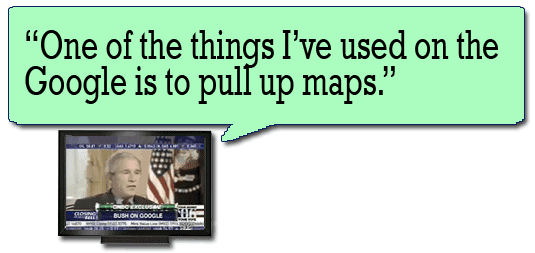
Why it’s notable: The leader of the free world was famously tongue-tied–and hey, he told Bartiromo he used “the Google” only “occasionally.” Whether he misspoke or didn’t know what the world’s favorite search engine was called, his fumble has been intentionally repeated countless times by others in the three years since he made it.
*This number probably overstates this quote’s Googleosity–sadly, the Google makes it hard to form a query that accurately captures references to Bush’s gaffe.
Why it’s notable: Steiner’s cartoon–whose caption is endlessly riffed upon to this day, often by folks who probably can’t identify where it came from–neatly summarizes the democratizing effect of the Internet. In retrospect, it’s amazing that it did it sixteen years ago–before Netscape, before Yahoo, and before many Americans had ever logged onto the Net at all.
4. Elwood Edwards, husband of an early AOL employee:
Circumstances of origin: Recorded in 1989 on a cassette recorder; debuted with AOL 1.0 in 1989.
Why it’s notable: Edwards, a broadcast-industry veteran and husband of an early America Online
employee, is the voice behind the three words that have been heard billions of times by millions of people over the past twenty years. (He was also responsible for the less iconic “Welcome,” and “Goodbye,” and “File’s done!”) “You’ve got mail!” is as emblematic of AOL as the surging sea of demo disks it once pelted us with; it was made into a movie and continues to serve as the inspiration for maybe half of all headlines relating to AOL. In short, it’s hard to imagine AOL without it.
3. George W. Bush, president of the United States:
Googleosity: 2,400,000 Quote type: Political blather.
Circumstances of origin: Uttered by the 43rd president during a presidential debate on October 8th, 2004. He also referred to “the Internets” during a debate on October 17th, 2000 and in an interview on May 2nd, 2007.
Why it’s notable: It may have been a simple slip of the tongue–okay, one made repeatedly over the course of years–but “the Internets” and its variant, “the Interwebs,” have transcended simple memehood. On much of the Internet, the terms are used in discussion of Internet-related matters that isn’t otherwise particularly wacky. I wonder if the former president knows he gave the Net this little gift, and if so, what he makes of it?
2. Al Gore, vice president of the United States:
Googleosity:3,490,000 Quote type: Political blather.
Circumstances of origin: During an interview on CNN’s Late Edition with Wolf Blitzer, March 9th, 1999.
Why it’s notable: Want to take a convenient cheap shot at the 45th vice president of the United States ? Join the untold legions who have accused him of having claimed to be the inventor of the Internet. Hoax-debunking site Snopes.com says that Gore “did not claim he ‘invented’ the Internet, nor did he say anything that could reasonably be interpreted that way.” Well, maybe–taken literally, Gore’s words do seem to say that he was a co-creator of the Internet, at least. (Originally known as ARPANET, the Internet went online in October 1969, when Gore was a recent college graduate.) As a Congressman and Senator, the famously tech-savvy Gore did play a major role in communications policy; if he had said he’d been instrumental in “developing” or “expanding” the Net rather than “creating” it, his statement would have unassailable–and it wouldn’t be in this article.
1. An intergalactic villain in Zero Wing, a 1991 videogame:
Circumstances of origin: It’s a piece of threatening dialog in the European edition of a Japanese game for Sega’s Mega Drive (aka Genesis) game console. Wikipedia helpfully provides the following improved translation: “With the help of the Federation Government forces, CATS has taken all of your bases.”
Why it’s notable: Beginning in early 2001, it became the most pervasive Internet meme this side of Rickrolling. It continues to flourish, spawning thousands of variants in discussions of everything from politics to public utilities to sports. Most of the people who riff on it can presumably tell you it originated in a game. But the percentage who can tell you which game–let alone who have actually seen it–is probably minuscule.
Any nominations of notable quotes I failed to include here–including ones that deserve to be better known than they are?
You might want to have a look at how search optimization sucks, click here.
To subscribe to the "Guy WhoSteals" feed, click here.
You can add yourself to the GuyWhoSteals fanpage on Facebook or follow GuyWhoSteals on Twitter.
We need as many Reddits we can get. To Reddit this post, click on the Reddit button to the right. To Digg this post, click on the Digg button on the right or use the Share button in the Wibiya bar.